Today’s post is going to be about RHUBARB, because where I live, it’s rhubarb season!
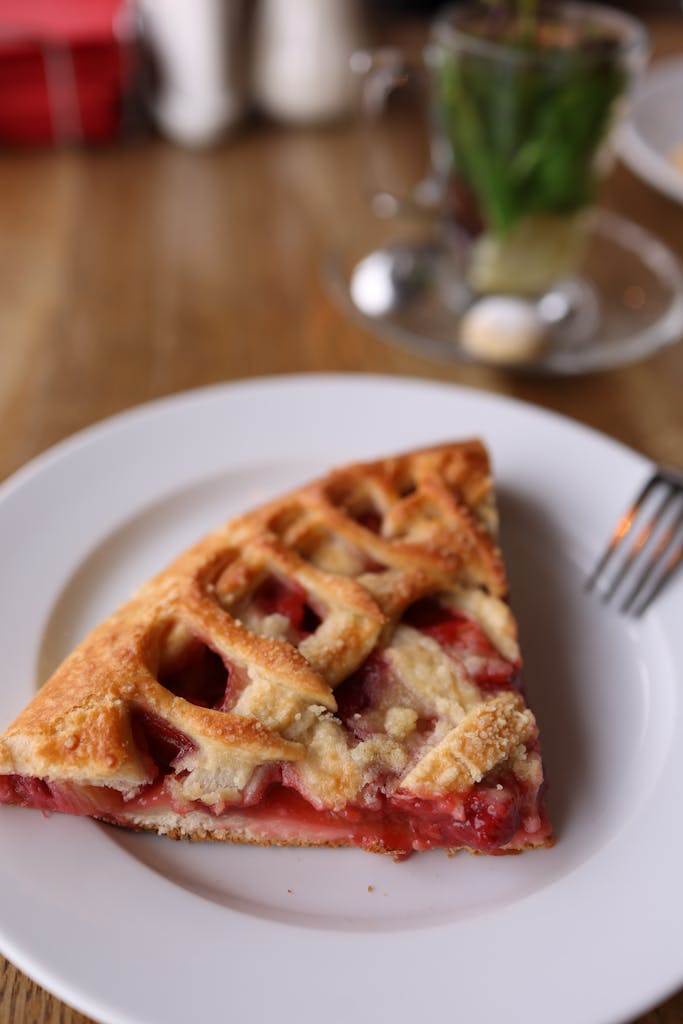
I love going to the farmer’s market in the early part of the season to get fresh rhubarb.
I tend to bake it into a pie, with or without strawberries, or alternatively, I make a simple rhubarb crisp. It has such a distinctive flavor that almost always lends itself to fruit-like applications such as jams and jellies, muffins and pies.
But is rhubarb a fruit? And if not, why is it treated like one?
Botanically speaking, the fruit of a plant is the edible part that develops from a flower and contains one or more seeds.
Now, we know how this definition has confused people about tomatoes, which are technically a fruit, but not treated as such from a nutritional standpoint. And to be honest, I don’t know why tomatoes are the only ones getting called out for being in this fruit-or-vegetable limbo.
Cucumbers, bell peppers, squash, and many others that we think of as vegetables are also the fruit of their plants.
By this standard, rhubarb is clearly not the fruit of its plant – it is the stalk, much like celery or Swiss Chard.
So, I wanted to dig a little deeper into the NUTRITIONAL DEFINITION of fruits and vegetables — not because it makes all that much difference practically speaking – we want to eat both, so who cares what category it falls into — but I was curious, so I imagine others may be as well.
IN GENERAL, fruits are higher in sugar and calories than vegetables.
Of course, there is a range – beets and carrots are higher in sugar and calories than cucumbers or celery, mangoes and bananas are higher in sugar and calories than blueberries and kiwi.
But for the most part, even higher calorie vegetables are well under the ranges we see for lower calorie fruits.
IN GENERAL, vegetables provide more fiber.
However, I don’t think this is as clear of a delineation, as there are definitely fruits that have more fiber than some vegetables.
For example, a cup of raspberries contains 8 grams of fiber, which even beats out veggies like broccoli and kale.
Also, in my opinion, fruits tend to taste SWEET, whereas vegetables do not.
Again, it may be a bit of a judgment call – lemons are fruit, but they are not very sweet. There is certainly a range of sweetness found in vegetables, but I don’t think of it as a predominant flavor.
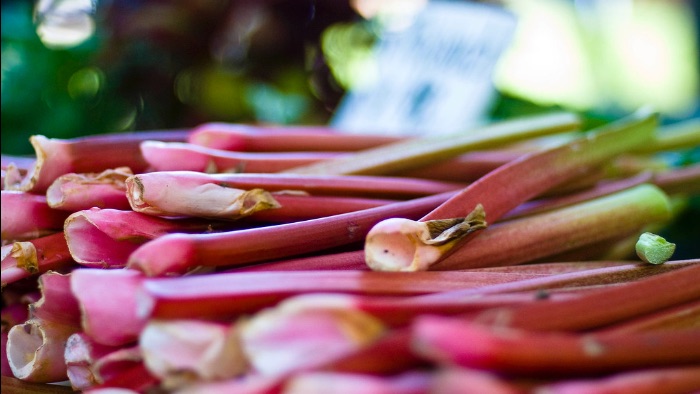
When it comes to rhubarb, there are about 26 calories in 1 cup, which is on the low end, placing it more in the vegetable category.
One cup has about 2.2 grams of fiber, which is great, though not decisive in my opinion.
The flavor of rhubarb is not sweet – it is far more tart than anything.
So why on earth are we making desserts out of this red/green stalk?
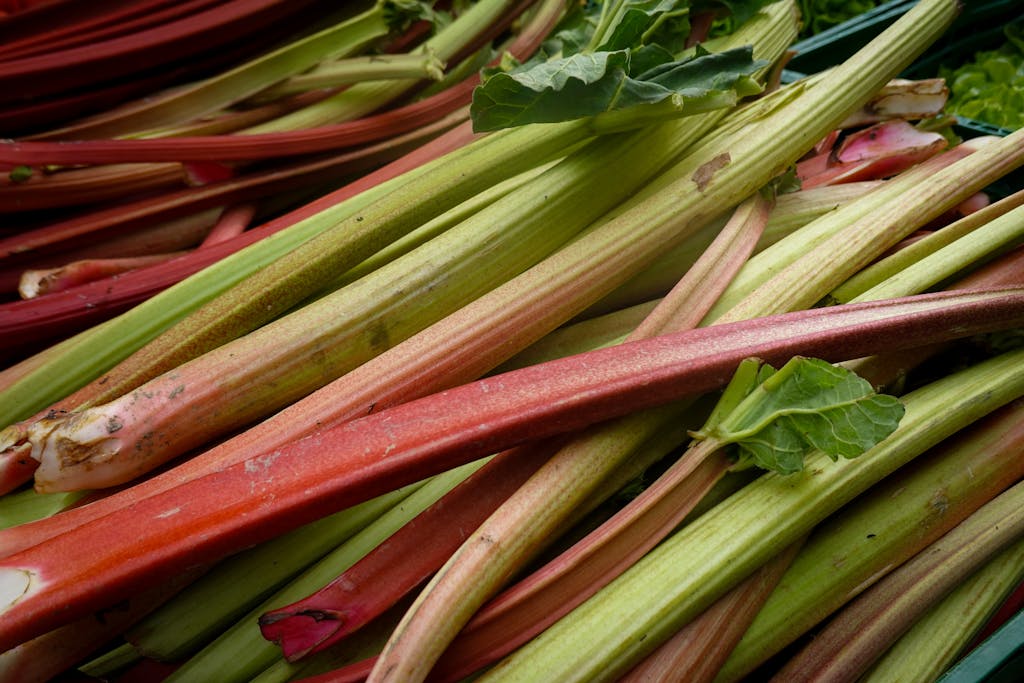
Although earlier, I mentioned botanical fruits that nutritionally are vegetables, I can’t think of any other botanical vegetables that tend to get lumped in with fruits.
Okay, maybe we do make things like carrot cake and zucchini bread, but those are not their most common forms.
I also can’t think of any other vegetable that has the type of tartness found in rhubarb, and that tartness tends to correspond more with fruit than vegetable – citrus, kiwi, sour apples.
From a culinary perspective, that distinctive tartness is likely the reason rhubarb finds itself treated with sugar rather than salt.
BUT a quick Google search will illuminate the fact that rhubarb can be used as a vegetable in savory preparations. I haven’t tried it that way myself yet, but as I know the enigmatic plant will be around for a bit longer, I aim to see what I can do with it beyond confections.
Either way, here are a couple more reasons why you might want to include rhubarb in your diet:
- good source of Vitamin K
- good source of fiber
- rich in antioxidants
- also a source of Vitamin C, Magnesium, Calcium, and Potassium

If you want to keep it classic……check out this video for my attempt at rhubarb pie.
Finally, if you, or someone you know, in IL could benefit from individual nutrition counseling, don’t hesitate to reach out. Click here to schedule a free consult.